
What are Cornell notes?
Cornell notes are a note-taking system developed in the 1950s by Walter Pauk, an education professor at Cornell University, and described in his book How to Study in College. Instead of writing everything in one column, you divide the page into three areas and use each at a different time: during class, right after class, and when you review.
The cue column turns review into retrieval practice: answering questions from memory instead of rereading. Research links retrieval practice to better long-term retention than rereading the same material (Roediger and Karpicke, 2006).
The Cornell notes layout
Facts, examples and diagrams, written during class. Short phrases, not full sentences.
A narrow cue column on the left, a wide notes column, and a summary across the bottom.
How to take Cornell notes in 5 steps
1. Set up the page
Draw a horizontal line about 2 inches (5 cm) from the bottom of the page for the summary. Then draw a vertical line about 2.5 inches (6 cm) from the left edge, from the top down to the summary line. Write the topic and date at the top.
2. Record during class
Use the wide right column. Write facts, definitions and examples as short phrases. Skip a line between ideas so you can add to them later. Don’t write in the cue column yet.
3. Write cues within 24 hours
Read your notes and, in the left column, write a question or key word next to each main idea. “What are the three stages of memory?” works better than “stages”, because it forces you to answer.
4. Summarize at the bottom
In two or three sentences, write what the page is about in your own words. If you can’t, that is the part to review first.
5. Recite and review
Cover the notes column. Read each cue and answer it out loud or on scrap paper, then uncover and check. Repeat over the following days, spacing the sessions further apart.
- Memory = encoding → storage → retrieval
- Encoding: brain turns what you see and hear into a pattern of activity
- Storage: pattern first kept in a fragile form
- Retrieval: bring the memory back when needed
- Hippocampus: deep in the temporal lobe; key for new long-term memories
- Consolidation during sleep moves memories to more permanent cortical storage
Reviewing: the notes column is covered and each cue becomes a question to answer from memory.
A filled example
Here is one page of Cornell notes for a short biology lecture, How Memory Works.
- Memory = encoding → storage → retrieval
- Encoding: brain turns what you see and hear into a pattern of activity
- Storage: pattern first kept in a fragile form
- Retrieval: bring the memory back when needed
- Hippocampus: deep in the temporal lobe; key for new long-term memories
- Consolidation during sleep moves memories to more permanent cortical storage
Cues on the left are written after class; each one tests a block of notes on the right.
Free Cornell notes template
Cornell notes template
Printable, with cue, notes and summary areas. US Letter and A4.
Cornell notes from recordings
If you record your lectures, you can combine the Cornell method with SummaryNote. The summary gives you the notes column; you still write the cues yourself, which is where the learning happens. SummaryNote’s flashcards then work like an extra cue column: a question on the front, the answer from the lecture on the back.
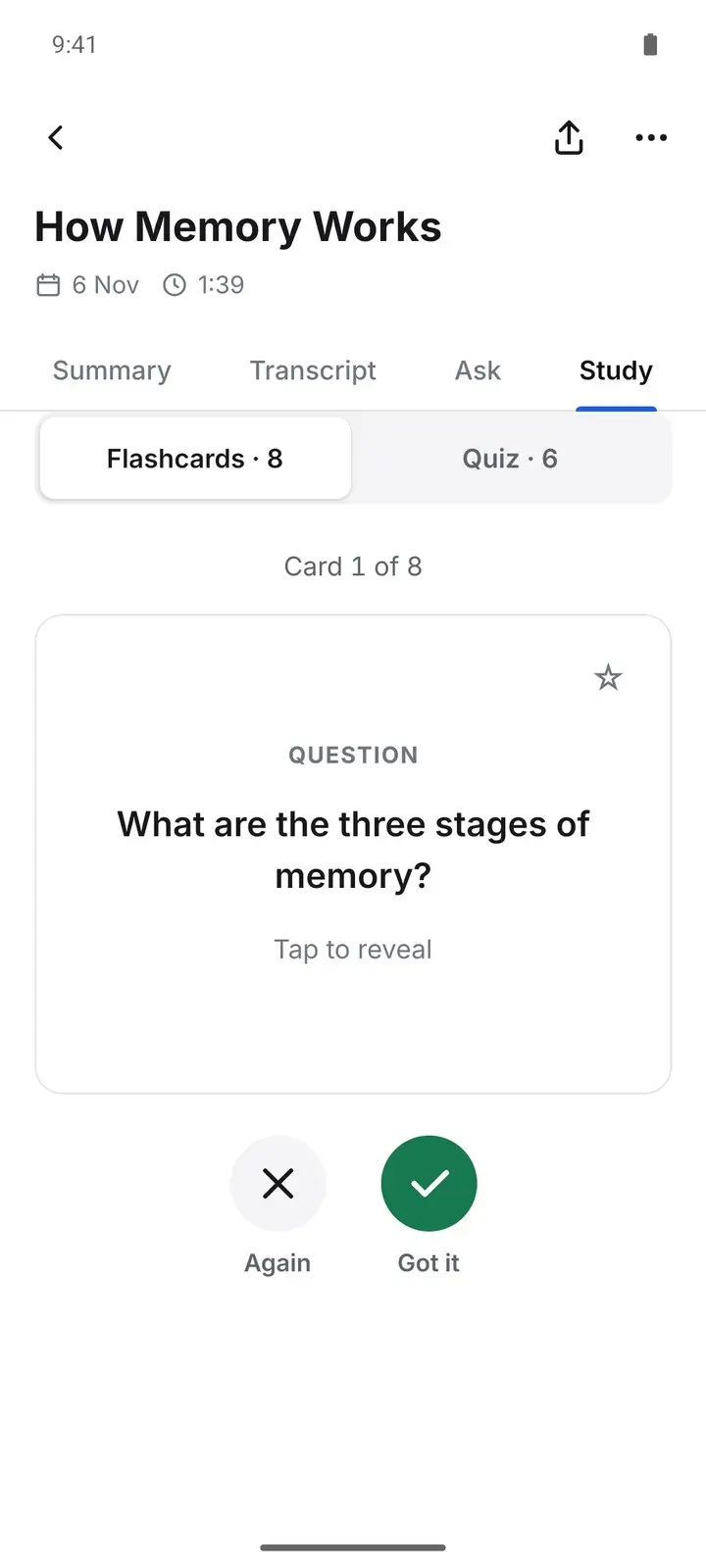
The same lecture in SummaryNote: a flashcard works like a cue.
FAQ
Are Cornell notes effective?
They are most useful when you actually use the cue column to test yourself, because that is retrieval practice, which research links to better long-term retention.
How wide should the cue column be?
About 2.5 inches (6 cm) on a letter or A4 page, roughly a third of the width. The summary area is about 2 inches (5 cm) tall.
Can I take Cornell notes digitally?
Yes. Use a two-column table in any document editor, or download our DOCX template.
Do Cornell notes work for math?
Yes. Put worked examples in the notes column and the type of problem or the key step as the cue.
We build SummaryNote, an app that turns lectures and meetings into notes, flashcards and quizzes. Our guides are reviewed against the sources cited. About us
Sources
- Walter Pauk and Ross J. Q. Owens, How to Study in College, Cengage Learning.
- Henry L. Roediger III and Jeffrey D. Karpicke, “Test-Enhanced Learning: Taking Memory Tests Improves Long-Term Retention,” Psychological Science 17, no. 3 (2006): 249–255.
