Interview Template

Download an editable template and use the filled guide to get started.

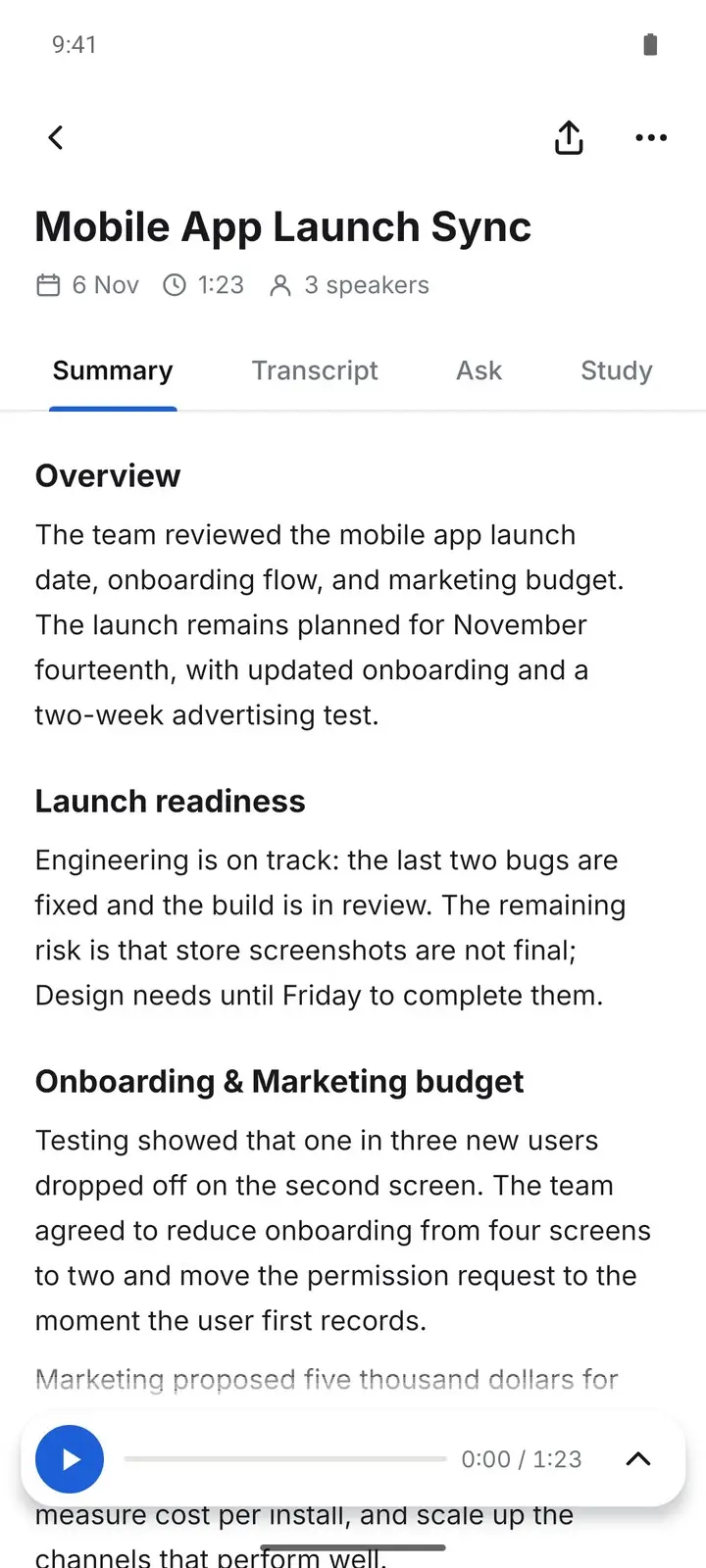
Summary in the Android app
Product designer interview

Questions · Answer notes · Quotes · Next steps

Filled template

Product designer interview

Interview details

Interviewee: Jordan Lee. Role: Product designer. Date: Thursday. Interviewer: Alex Kim.

Questions and answer notes

How do you approach a design problem? Jordan starts by understanding the people affected and the constraints.

Key quotes with timestamps

At 00:45: “I start by listening to the people using the product.”

Strengths and concerns

Strength: clear research process. Concern: follow up on collaboration with engineering.

Overall summary

Jordan described a thoughtful approach to research and iteration.

Next steps

Share notes with the hiring team and arrange a follow-up.

How to write interview notes in 3 steps

Prepare

Fill in the person, role or research topic, date and interviewer, and write the questions you plan to ask in the order you will ask them. Ask for consent before you record and note that you did.

Ask and listen

Under each question, write short answer notes in the person’s own words where you can. When something matters, mark the exact quote with the time in the recording so you can find it again.

Review and follow up

Within a day, separate what was said from your impressions, summarize strengths and concerns or the main themes, and record next steps. Share only what the people who need it should see.

What should interview notes include?

Use these components as a starting point, then adapt the template to your purpose. The filled template above shows how the pieces fit together.

Interview details

Record the person, interviewer, date and role or research topic. Add the context needed to distinguish this conversation from others, while avoiding personal details that are irrelevant to the purpose.

In practice: Jordan Lee · Product designer · Interviewer: Alex Kim.

Purpose and preparation

State what you need to learn and review relevant background before the conversation. A focused purpose helps you choose useful prompts without assuming what the person will say.

In practice: Understand how the designer investigates a new problem and works with engineers.

Questions and prompts

List core questions and leave space for follow-up questions that clarify an answer. A consistent starting point makes comparison easier while leaving room to explore an unexpected but relevant detail.

In practice: How did you decide which research method to use? What changed afterward?

Answer notes

Capture the substance of each answer with enough context to make it meaningful later. Use concise language, distinguish the speaker’s account from your own interpretation and mark anything you need to clarify.

In practice: Jordan described observing new users before changing the onboarding flow.

Quotes and timestamps

Mark useful phrases with a timestamp and check the recording before presenting exact words as a quote. Keep the surrounding question and context so a short passage does not misrepresent the speaker’s meaning.

In practice: At 00:45: “I start by listening to the people using the product.”

Evidence and observations

Separate what the person said or demonstrated from your interpretation of it. Record specific behavior or a concrete account so another reader can examine the evidence and reach an independent view.

In practice: Evidence: described testing two prototypes; interpretation: uses feedback to revise.

Themes or assessment

Group observations under research themes or criteria relevant to the role. Tie each conclusion to evidence, note conflicting information and identify gaps that require a follow-up rather than filling them with assumptions.

In practice: Research theme: participants struggled to find the first task; verify with other sessions.

Summary and next steps

Summarize the most relevant points and record a follow-up owner. Keep the summary grounded in the detailed notes, and describe what will happen next without presenting an unresolved question as a decision.

In practice: Alex shares the research notes with the project team and checks one open question.
Interview notes for every type of interview

Adapt the same structure to the outcome you need.

Hiring interviews

Use the same role-related questions and criteria for each candidate. Record evidence before comparing assessments with the hiring team.

Research interviews

Organize notes by goals, behaviors and obstacles. Preserve unexpected observations instead of forcing answers into an existing hypothesis.

Editorial interviews

Keep quotes alongside their context and mark where they occur. Verify wording against the recording before publication.

Stakeholder interviews

Note priorities, constraints and open questions. Compare areas of agreement and disagreement before making a shared plan.

Tips for fair, useful interview notes

1. Separate facts from impressions

Write what the person said or did before your interpretation. Label assumptions so readers can distinguish evidence from opinion.

2. Mark quotes with timestamps

Note when a useful phrase occurs and keep its context. Verify exact wording against the recording before sharing.

3. Write while the conversation is fresh

Review and complete notes within 24 hours. Flag anything you cannot confidently reconstruct.

4. Use consistent criteria

Apply the same relevant criteria to candidates and connect assessments to evidence. For research, use shared questions while leaving room for unexpected themes.

5. Agree on handling and follow-up

Ask permission before recording and share notes only with people who need them. Record open questions and a next step.

Common mistakes

Use these checks to make notes more accurate, fair and useful to the people who read them.

Confusing impressions with evidence

A broad judgment can hide the reason behind an assessment. Write the relevant answer or behavior first, then label your interpretation and connect it to the purpose of the interview. If the evidence is incomplete, record the gap rather than guessing.

Asking leading questions

A question that suggests the desired answer can narrow what you learn. Replace it with an open prompt and ask for a specific instance, then use neutral follow-up questions. Leave room for the person to describe an experience that differs from your expectations.

Quoting from memory

A memorable phrase may change meaning when it is detached from its context. Mark the time, review the surrounding exchange and verify the wording against the recording before sharing a direct quote. If you cannot verify it, describe the point as a paraphrase instead.

Collecting irrelevant details

Personal details unrelated to the research question or role can distract readers and introduce bias. Limit notes to information needed for the stated purpose, and use the same relevant criteria across comparable interviews. Share the resulting notes only with people who need them.

How to share and follow up

Before the interview

Share the purpose, practical details and any preparation the participant needs. Agree who will ask questions and who will take notes, and prepare the core prompts with space for follow-up. For a hiring panel, align on role-related criteria before meeting candidates.

Ask permission before recording and explain how the recording and notes will be used. If the person does not agree, use an appropriate alternative such as written notes and confirm the arrangements with everyone involved.

After the interview

Review and complete the notes within 24 hours while the context is fresh. Check important quotes, flag uncertain details and separate observations from conclusions before discussing findings with others.

Share the relevant summary and next steps with the people who need them, according to your organization’s handling practices. Store the template with the interview notes and any permitted recording so readers can return to the source; assign an owner for open questions and follow-up. When several interviews inform a shared decision, compare the evidence across conversations before drawing a conclusion. Note where accounts differ and what further information would help, rather than treating every participant as if they had the same experience.

Questions, answered

What should interview notes include?

Include the interview details, purpose, questions, answer notes, verified quotes, evidence, themes and next steps. Adapt the fields to the role or research question.

What is the difference between structured and unstructured interviews?

A structured interview uses a consistent set of questions and criteria; an unstructured interview follows a more open conversation. A semi-structured approach combines core questions with flexible follow-up.

Should I ask permission to record?

Yes. Ask before recording, explain how it will be used and respect the participant’s response. Follow the applicable rules and your organization’s recording practices.

When should I write up my notes?

Review and complete them within 24 hours while context is fresh. Mark anything uncertain and check the recording, if you have permission to use it, before quoting.

How can I avoid bias?

Use relevant, consistent criteria and open questions. Separate observations from impressions, support assessments with evidence and avoid recording unrelated personal details.

How do I capture accurate quotes?

Mark a timestamp and verify the exact words and surrounding context against the recording. If you cannot verify the wording, use a clearly labeled paraphrase.

Can I use the template for research?

Yes. Replace role assessments with research themes, behaviors and open questions. Keep unexpected findings alongside evidence rather than forcing them into an existing hypothesis.

Is the template free and automatic?

The editable DOCX is free to download without an account. Fill it yourself and use SummaryNote to review a recording and transcript when appropriate.

Turn a recording into notes

Record or upload a recording and review the summary and transcript.

Your notes list in the Android app